But the wisdom from above is pure first of all; it is also peaceful, gentle, and friendly; it is full of compassion and produces a harvest of good deeds; it is free from prejudice and hypocrisy. And goodness is the harvest that is produced from the seeds the peacemakers plant in peace.

James 3:17


Thursday, June 19, 2014

Joel Baden, The Historical David

A book review of Joel Baden, The Historical David: The Real Life of an Invented Hero (New York: HarperOne, 2013)

In his introduction to The Historical David, author Joel sets out to discover the real David of history.  He begins with two central theses: first, that there was indeed a historical David, a real-life individual; and, second, the stories about him in I and II Samuel are largely but not entirely fabrications that obscure rather than reveal that David.  They were written to transform him into a foundational, mythic figure something on the order of our American stories about George Washington, only much more so.  The biblical stories, that is, are the ancient equivalent of "spin," and Baden's goal is to separate the spin from reality.  He intends to pursue his goal by unearthing and discarding the obviously non-historical elements from the biblical stories while also placing David in his historical context including taking into account the ancient literary conventions employed to glorify him (see p. 13).  The question is, of course, just how successful is Baden in all of this?

A troubling note in his introduction suggests that the reader must proceed carefully, applying to Baden the same level of critical mistrust that he applies to the biblical text.  He states somewhat in passing that he intends to understand the David narratives "from an objective historical perspective" (p. 10).  It sounds like a worthy goal but for the fact taught on the first day of Historiography 101 that there is no such a thing as an "objective perspective," historical or otherwise.  It is widely understood among historians that "objectivity" is a tricky concept at best especially when it is applied to the study of the past.  This is a rookie mistake that a scholar of Baden's stature should not make, and it does not bode well for what the reader might anticipate next.

Before getting into what comes next, it should be acknowledged that The Historical David is well-written and clearly argued.  Baden knows his subject and conveys his enthusiasm for his quest throughout the book.  He believes in what he is doing.  Furthermore, he adheres to the biblical chronology of David's life rather than following a topical format, a wise choice generally when writing history.

The problem he faces as a historian however is that it is virtually impossible to write a history for which there is so little evidence.  The second fact introduced in Historiography 101 is that historians live and die by the quality of their historical resources, and Baden has only one source, the Bible, which is notoriously difficult to use for the historiographical study of the past.  This slim evidential base unfortunately invites researchers to take "inventive" approaches, which can all too easily lead to a level of speculation that first skirts the boundaries of circumspection and restraint and then exceeds those boundaries entirely.  Baden has fallen prey to these temptations of a lack of evidence, although it is sometimes difficult for non-specialist readers to determine if he does or not because he knows his field well enough so that he can see things the uninitiated do not see, make connections those less knowledgable can't make.  That being said, it is still the author's responsibility to make his arguments as transparent as possible.  Baden writes for a general audience, and it is up to him to keep that audience as clued in as possible, which he fails to do.  He, in particular,  provides his readers with virtually no information about the text or its convoluted history.  He simply asserts that the relevant texts, I and II Samuel, lie close to the time of David and can be mined for relevant historical data concerning him.

Another mistake made by the author is that he confuses the text with events by assuming that the text contains all of the relevant information concerning David needed to write his history.  If the text does not contain details or background concerning a particular event or person, then for Baden there are no details or background at all.  Observing, for example, that the prophet Nathan appears in the text only three times in a way that makes him appear to be a literary construct, Baden decides that there never was an actual person, Nathan.  If the text treats him as a literary construct, then he must be only a literary construct.  The flaw in his logic is clear, which is that simply because the text appears to use the prophet as a literary construct says nothing about whether or not such a person actually existed.  In fact, we could argue just as logically that if the original text was as close to the time of David as Baden claims, it would not be logical that the biblical authors would assert the pivotal importance of a figure the readers would know did not really exist.  Baden's claim that there was no Nathan, that is, carries no weight whatsoever.  It is speculation based on a single historical source read in a particular way.

Baden's methodological approach to the text is as flawed as is his assumption that it contains all of the relevant information needed for a biography.  Entirely ignoring the text's theological concerns, he treats it as a political document intended to glorify David and his royal house at the expense of Saul and other opponents.  His fundamental working hypothesis is that the biographer of David cannot take the text at face value.  It is an apologetical work and must be treated with suspicion at every turn.  In effect, Baden assumes that wherever the text speaks positively about David or negatively about his enemies the text is in error.  Wherever it embellishes or goes out of its way to paint a positive picture of David, it is historically wrong.  The biographer thus must discern the nuggets of historical truth hidden within the text through a "close reading" of its contents while being aware of the logic of its narrative.  The biographer, according to Baden, thus must make sense out of the text in order to reconstruct actual events by stripping away those things don't seem to make sense, aren't apparently logical, or appear unrealistic.  What we are left with in The Historical David is Baden's own scholarly intuition as to what "really" happened.

What we are left with, that is, is a surmised history consistently based on speculation born of Baden's own idea of what makes sense.  He asserts time and again that the text can be read logically only in a particular way where, in fact, one can think of other ways to read the text that would allow events to stand as described there.  Baden rejects the possibility of coincidences and happenstance.  He insists that events have to proceed in a logical fashion.  If something in the text seems improbable, then for Baden it did not happen.  This is simply not the way history is written.  Coincidences do happen.  People frequently do not behave in logical ways and often enough they do things that are not in their best interest.  There are black swans.  The past that actually happened is remarkably illogical, and while a measure of common sense is important in the writing of history it has to be based on what what was commonsensical in the time and place being studied.  When one studies nineteenth-century Protestant missionary history in Thailand, thus, missionary behavior often seems lacking in common sense until one understands the cultural, ideological, and theological underpinnings that informed their world view.  Given that understanding, they were remarkably consistent in behaving in ways that made perfect sense to them at the time.  Baden never struggles with the sensibilities of ancient times in discerning what seems to be logical and illogical to him.

One example will have to suffice here of the weaknesses in analysis that are found throughout the book.  In a section entitled, "David and the Philistines" (pp. 99-101), which supposedly documents David's time living among the Philistines (I Samuel 27).  Baden speaks with authority regarding David's motivation and what he wanted to accomplish without any reference to the biblical text.  Speaking to a historical figure's inner state is always tricky even when documentation exists, but here Baden speaks to David's mindset in spite of no evidence at all other than his own surmises as to what it might have been.  And even so, he asserts his assumptions concerning David's state of mind without equivocation.

Baden then goes on to assert that the biblical account is "thoroughly improbable," (p. 101) a somewhat confusing wording that apparently is intended to make "improbable" sound as if it is really impossible.  According to the text, David, who was living among the Philistines, fooled them into thinking he was raiding Hebrew towns when if fact he wasn't.  It is this that Baden finds improbable—improbable that the Philistines wouldn't have known what David was up to.  Again, his rendition of events is anchored in logic rather than evidence.  Logically, he decides that David didn't attack the cities the text said he attacked, and logically he decides that David actually attacked communities in Judah, which the text says he didn't.  Throughout his rendition of events, Baden uses such words as "improbable," "unlikely," and "probably," leaving the reader with nothing to hang on to but the author's speculations.

This is not history.  This is not how history is written.

Baden's treatment of the text, in fact, is confusing.  On the one hand, he is almost a literalist.  He seems able to discern specific scenes and detailed events that he assumes happened in real time, but on the other hand he rejects almost out of hand the text's presentation of those scenes and events.  Where other biblical literalists take the text to be inspired and always right as given, he verges on taking the text to be consistently obscured by politically motivated spin and thus open to right interpretations.

None of this works in the end.  Baden's David is a figment of his speculative, intuitive imagination.  At times, the reader feels that Baden may be correct in some of his surmises and assertions, but for the most part it is clear that we learn very little about the "real" David.  We are better off admitting that he is beyond all possibility of historiographical reconstruction in any meaningful way.  The text that we have is essentially a theological document that tells the story of God's dealings with the Hebrew people in ancient times.  In this story, David is a flawed hero of the faith.  Saul is an enemy of faith.  Nathan is a key figure, appearing at axial moments.  This is not to say that the text has no historiographical value.  It does, but not as a source for specific events minutely dissected.

The bottom line is that unless one enjoys historical fiction, this is not a book worth buying.  All it reveals is our profound ignorance of actual events and persons in biblical Israel's past.

An added thought: in some ways, The Historical David stands as something of a judgment on the vast literature concerning the historical Jesus.  Every author of that genre seems to discover a different Jesus in the past—a prophet, a mystic, or a revolutionary.  In truth, the historical Jesus is only a little more accessible than the historical David.  The four gospels are essentially faith documents constructed out of a logic or common sense very different from those of modern-day historians.  They tells us far more about the beliefs of the earliest generations of Christians about Jesus Christ than they do the actual "real" Jesus of Nazareth.  The Historical David is thus almost a cartoon caricature of the literature on historical Jesus.


Tuesday, January 14, 2014

David Backes, A Wilderness Within: The Life of Sigurd F. Olson

A book review of David Backes, A Wilderness Within: The Life of Sigurd F. Olson (Minneapolis: University of Minnesota Press, 1997)

Growing up in Minnesota, there were always books by Sigurd F. Olson (1899-1982) on the bookshelf and frequently on the end table next to my Dad's chair. And our summer vacation trips were always Up North in the Boundary Waters canoe country.  I took my first canoe trip when I was 15, and it has remained a high point ever since. All of which is to say that Backes biography of Olson brings back for me memories of both the man and the land he celebrated in his writings and his life.  It is my privilege to again live for a time on the edge of a northern semi-wilderness, which means that Backes portrayal of Olson conjures up not just memories from the past.  It also reminds me of why living in the North Country remains a privilege.

In this context, there is a great deal in A Wilderness Within that resonates with the reader.  It is a generally good read.  It is well-written.  Backes obviously knows his material and has done his research.  He adheres to the timeline of Olson's life quite closely, and he reveals something of the complexity of the man.  This is not a hagiographic work of unmixed admiration, although it is clear that the author does admire and deeply respect his subject.  Perhaps the one serious criticism I have of the book is that so little of Olson's actual time in the wilderness is described here.  His sometimes long trips into the wilderness receive mostly only passing attention in the context of other matters and seem to be significant more for the people Olson met on them than they were in and of themselves.  That being said, in general Backes provides his readers with a nuanced, clear, and interesting portrait of Sigurd Olson.

Backes does a particularly good job in describing for us the fact that from an early age Olson was on a spiritual journey, a quest for meaning.  He was raised in a strict fundamentalist Christian home, which set him on a course for a search for God.  At the same time, he was raised in northern Wisconsin, which gave him the wilderness context within which he conducted that sometimes agonizing search.  The third leg of the tripod of Olson's life, as described by Backes, was his love of writing and the desire to use writing to communicate to others his philosophy of the wilderness as a wellspring of our spirituality.  It took him decades to discover the genre appropriate to his style and sense of mission, and therein lies one key to the course of Olson's life, which was not always easy.  He battled depression.  He was sometimes hard to live with at home.  He resented having to make a living that kept him out of the wilderness and away from his writing desk.  But eventually Olson eventually became a full-fledged writer, beginning with his well-known first book, The Singing Wilderness, published in 1956.  From that initial success, he became a widely read and influential voice for the wilderness, which remained the dominant motif of his life to his last day.

Olson on the trails
Olson, as Backes tells the tale, also became an important figure in the wilderness conservation
movement.  He led several organizations dedicated to the preservation of the wilderness as well as serving as an advisor to governors and national political figures on conservation issues.  For decades, he was in the thick of the political wrangling over the use of what remains of the wilderness in the United States.  Backes points out that as much as he was admired around the country the one place where he was least popular was in his hometown of Ely, Minnesota, because he seemed intent on thwarting its economic development by keeping loggers, resort developers, and other despoilers of the wilderness out of the woods.

The main theme through all of the book, however, is Olson's spiritual quest for meaning, which he found in the experience of wilderness "epiphanies" in the rugged wilderness of the Quetico-Superior canoe country.  He was an expert woodsman.  He loved nothing more than being in the wild.  And he developed a wilderness philosophy-theology built on his experiences in the woods, which held that the wilderness remains a presence deep within us—a "racial memory" of evolutionary proportions.  It was where we became human, and it is where we lived and development for countless generations.  We still need to be in the wilderness because it is there that we discover (or recover) what is good, meaningful, and important in life.  In later years, Olson did a good deal of reading in philosophy, theology, as well as in the literature of conservation and developed his wilderness philosophy-theology accordingly.  Backes especially highlights Olson's spiritual journey and his thoughts on the meaning of wilderness in Chapter 14, which is entitled, "From Contemplation to Action: Sigurd Olson's Wilderness Theology, 1959-1964," (pages 286-313).  [See Backes, "The Land Beyond the Rim: Sigurd Olson's Wilderness Theology," for a further description of Olson's wilderness spirituality].  It should be said that Olson's theology was not an orthodox, trinitarian Christian one although it is clear that it has its roots in Christian thinking about the divine.  He belonged to the Presbyterian Church in Ely, but Backes leaves the impression that organized religion was not particularly important to him.

Acknowledging that Olson became an icon of the conservation movement, Backes strives for a balanced and critical account of his life and largely succeeds.  Olson was not a happy man for most of his life.  His dream of becoming a writer was as much a source of suffering over the course of the years as it was happiness.  He seems to have enjoyed praise and attention a little too obviously, and there were long periods when he was inattentive and even insensitive to his family. In the end, however, Backes leaves his readers with the impression that these admitted defects only serve to underscore the greatness of the man.  He overcame many obstacles, internal as well as external, in the course of his life and made an important difference in his time.  Olson was something of a people's philosopher-theologian, as comfortable with a rod, a paddle, or even a gun in his hand as a pen and as happy sitting in a duck blind as over a typewriter.  He could be bold and tough, but as a college dean he devoted himself to his students who loved him.  So, what comes through by the end of the book is that Sigurd Olson did become a beloved, deeply respected, iconic figure by the time of his death.  He was a leader, whether on the water or in a boardroom—and people followed.

Backes' The Wilderness Within is straight-forward and without frills.  In that sense, it reflects in its style something of the man it describes.  For those interested in the wilderness, spirituality and theology, the history of the conservation movement, or who simply enjoy a good biography, this is a book well worth reading.  I highly recommend it.

Wednesday, December 18, 2013

David Hackett Fischer, Champlain's Dream

A book review of David Hackett Fischer, Champlain's Dream (New York: Simon & Schuster, 2008).

At once a biography of Samuel Champlain (1574-1635) and a history of the founding of colonial New France, Fischer's Champlain's Dream is also in part at least a work in Christian ethics, which points to the difference the application of Christian values can make in the real world.  Champlain's Dream is  a well written, carefully researched, and timely work devoted to an important and fascinating slice of the past, all of the things we expect of Fisher.

As Fischer portrays him, Champlain was a man who was born into violent times and was a soldier, but he became something much more than just a warrior.  He was born into a France that was rent with religious divisions between Catholics and Protestant and himself converted from Protestantism to Catholicism but learned to transcend these divisions.  He lived in a time when politics was as complicated and brutal as ever, and he played the political game when necessary but only in pursuit of his dream for a French colony in North America.  Finally, what Champlain found in the great St. Lawrence River valley was a large set of Indian tribes engaged in constant warfare with each other and weary of that warfare; and he managed to bring a certain degree of peace to the warring tribes for a period of time in pursuit of his dream of a peaceful, prosperous New France

A self-portrait of Champlain
All of this, according to Fischer, grew out of Champlain's Christian faith.  Fischer is careful to keep Champlain in his own time so that he doesn't end up being a seventeenth century version of a modern-day progressive Christian.  Champlain believed in monarchy.  He accepted a hierarchical society as perfectly natural.  He was a patriotic Frenchman.  Still, he wanted Protestants to have a place in New France along side of Catholics.  Perhaps even more remarkably Champlain respected the Indians he worked with, valued much of their cultures, and sought to live with them in a fair and peaceable union that did not lead eventually to their near extermination.  And all of this was because of the way Chaplain interpreted and applied his Christian faith.

It is clear that none of this came easily for Champlain.  He made powerful political enemies and always had to contend with conflicting financial interests that sought to exploit French North America at the expense of his vision.  In New France, he had to contend with the Iroquois, who never made peace with the French, and he was forced to attack them in order to deter their attacks on the colony and on its allied tribes.  On the home front, he had a complicated relationship with his wife, Helene, that never produced any children and ended up with her entering a convent.  At one time, New France was seized by Scottish merchants based in England and Champlain was made a prisoner until he was finally returned to France.  Through it all, however, he persevered in his pursuit of his vision of a peaceful and prosperous New France grounded on Christian principles.  He, for example, promoted exchanges of young people between the French and the Indians so that both sides gained a better appreciation for the cultures of the other.  Many of the French young men because interpreters for the French, not just of Indian languages but also of their ways of life.

In his concluding chapter, Fischer writes,
Many stories have been told about first encounters between American Indians and Europeans.  Few of them are about harmony and peace.  The more one reads of these accounts, the more one learns that something extraordinary happened in New France during the early seventeenth century—something different from what took place in new Spain, New England, and New Netherlands.  Scholars of many nations agree that the founders of New France were able to maintain good relations with American Indians more effectively than any other colonizing power. (p. 527)
Fischer credits those good relations primarily to Samuel Champlain who he characterizes as a man of deep religious faith as well as a member of a group of French humanists who originally formed around King Henri IV.  Champlain himself was close to the king.

One could well argue that New England was just as much a product of the application of Christian beliefs and values as New France, but with an outcome that was very different.  The Indians were pushed into open war, treated with disdain, and eventually the "Indian problem" was solved by their near extermination.  While Fischer points out that there were compassionate English settlers and insensitive settlers among the French, one of his key points is that the differences between the practice of Christianity in New France under Champlain and the practice of the faith in other colonies such as New England led to very different outcomes.  The outcome in New France was more Christ-like.  It was less dualistic and less brutal.  It was less ideological and less destructive.  It was more dialogical and more just and peaceable.

Fischer did not write Champlain's Dream as a work of theological reflection, but much of what he wrote provokes, almost demands that reflection.  But whether or not it is viewed theologically, Fischer's Champlain's Dream is a well-crafted historiographical work. It is a comprehensive study that includes a lengthy literature survey, a set of sixteen appendices on a range of issues and subjects related to Champlain's life and times, and an extensive bibliography.  The book is richly illustrated and contains a good set of maps.  All-in-all, this is an excellent book generally and one that is well worth consideration by students of Christian theology and ethics.

Friday, August 16, 2013

Sigurd Olson, Reflections from the North Country

A book review of Sigurd F. Olson, Reflections from the North Country (Minneapolis: University of Minnesota Press, 1998; originally published by Alfred A. Knopf,1976).

He disguised the fact well, but in truth Sigurd Olson (1899-1982) was an academic, however much he was best known in his day as a man of the wilderness, especially the northern wilderness of the "boundary waters" of northern Minnesota and western Ontario—the Quetico-Superior country.  He was also an author who wrote a series of popular books on his life experience with the wilderness.  Reflections from the North Country, published in 1976, is one of his last works, and in it readers begin to see more clearly the widely-read academic who over the years had worked out a personal theology wrapped around the idea of an "emergent God," which is a symbol of what humanity aspires for—that which is beyond knowing and definition.

In these reflections, Olson assesses his experience with northern wildernesses, how those experiences shaped him, and what they mean for him and for the whole human race.  It is clear throughout Reflections from the North Country that for Olson life in the wilderness is essentially a spiritual experience.  In the silence and beauty of the wild, Olson discovered a form of meditation that is natural and simple, one that doesn't rely on spiritualistic techniques or the technologies of elaborate forms of meditation.  If Olson had a religion, it was the woods and waters of the North.

The antagonist of Reflections from the North Country is urban, technological, consumer-istic, noisy, self-indulgent, pollution-ridden, and irreverent modern technological society.  Often in theology one describes God by exploring what  God is not, and technological consumer society fulfills that spiritual function for Olson.  What particularly concerns him is the way people live in modern society.  They hurry, pay no attention, are tense and troubled, chase after superficial priorities, and live at a distance from nature and who they really are.  Modern society and its anti-spiritual values are destroying the natural world that we depend upon for everything.

Nature, however, remains a powerful spiritual force that is able to transform the lives of those who are willing to submit themselves to the disciplines of wilderness living, if even only for a few days.  Olson reports how men (never women) who travelled with him on canoe trips invariably began to relax, smile, slow down, and come quietly and happily alive in the course of their time in the wilderness.  The interplay between wilderness as protagonist and modern society as antagonist thus lies at the heart of Reflections from the North Country.  There is little good to be said for society, although it does provide us with the insights into the nature of the wilderness provided by science—and thereby places wilderness in its vast evolutionary setting.  By the same token, there is little that is wrong with the wilderness.  In it is found wisdom, silence, serenity, the discipline of fishing, and good eating.  It is a place of unparalleled beauty; it is where we find meaning in life.  In sum, "Wilderness can be appreciated only by contrast, and solitude understood only when we have been without it." (page 35).

Listening Point, Olson's cabin in the North Woods
Olson expresses a deep appreciation for aboriginal peoples, Eskimos and American Indians.  He admires the way in which they are connected to the wilderness in a subliminal way, which in fact is our common heritage.  The rest of us, however, have lost touch with that deep, hidden place in us that connects us to the wild.  Olson thus poses the central question of his reflections, "...how can [modern man] nurture these desiccated nerve ends of his ancient knowing and make them flower again into a fuller life, with more appreciation of beauty and awareness and the potentialities of our relationships to others?"  His immediate answer: "...by placing ourselves in the proper situation and mood, and willfully recognizing there is something we possess that is normally hidden and lost to the modern mind." (page 24).  In a word, we have to expose ourselves to the wilderness, which for Olson is the Eden we are willfully losing and the Kingdom of God (to mix metaphors) to which we must return.  We have to escape the rat race and attain a "Godlike leisure," which can be done only in the wild places of the Earth (page 31).

Everything that matters is at stake in the interplay of wilderness and the modern, technology-driven world.  If we lose the wild, Olson was convinced, we lose our souls.  The very future of the human race is put at risk.

Being in the wilderness was for Olson a spiritual experience, a mystical encounter.  Quiet time spent watching a sunset, feeding squirrels, caring for the forest's trees and flowers, or just gazing intently at an ants' nest brings us peace.  This was his form of meditation.  He refers in Reflections from the North Country to the "great silence" that he experienced in the wild and to a sense of oneness that at times accompanied it.  Once one has felt these things then, "...comes the search for the ultimate, which only knowledge of the earth, the universe, and man's relationship to it can bring." (page 56).  Olson concludes Reflections from the North Country with a quick dip in the cold, clear waters of theological reflection.  He speaks of listening to the wilderness with our inner senses of seeing and hearing, by which we discover our oneness with God's creation and may even experience communion with God.  We need to understand that Olson's God is not the traditional one preached from church pulpits.  He refers to the "emergent God," a shadowy divine reality that is as much symbol tied to the human spirit and revealed in our contemplative experiences with the wilderness as anything else.  God is our goal and, somehow, also embedded in our human evolution.  Olson believes that one day all of humanity will be united in its knowledge of this God that stands "beyond absurdity."

Twenty-first century readers will find some things about Olson's Reflections from the North Country "quaint" or irritating, depending on the reader.  Writing in the 1970s, Olson does not avoid the use of sexist English.  It is clear at various points, moreover, that his imagined readers were men, and his tone in a few places is even a bit "manful," for want of a better term.  In more recent decades, furthermore, we are striving to think beyond simplistic dualisms, and to a degree Olson's contrast of wilderness and technological society is a rather simplistic dualism.  Urban activists and those who thrive on city living are likely to find his attitudes objectionable and even arrogant.  Olson also has a disdain for religious forms of meditation other than his own quiet contemplation of nature.

That being said, the core of this book is solid.  It calls its readers to value creation and to see themselves as connected to the rapidly disappearing wilderness places of our planet.  Reflections from the North Country is also simply written and without pretension.  For those who love the wild this book is an excellent companion to their wilderness experience, giving that experience deeper meaning by placing it in a cosmic, evolutionary context.  For this audience, Reflections from the North Country is as timely and even as inspiring today as it was for readers forty years ago.  If you love the wild, I highly recommend this book to you.
----
For further insights into Olson's spiritual approach to the wilderness, see David Backes, "The Land Beyond the Rim: Sigurd Olson's Wilderness Theology."

Wednesday, July 31, 2013

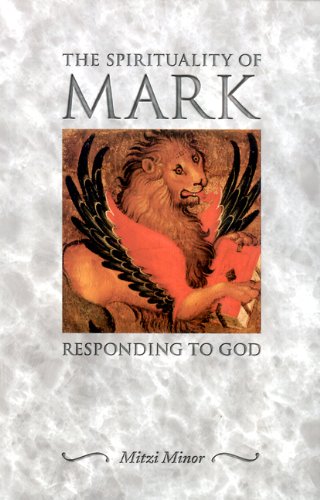
Minor, The Spirituality of Mark

A book review of Mitzi Minor, The Spirituality of Mark: Responding to God (Louisville, KY: Westminster John Knox Press, 1996).

Vast amounts of scholarly attention have been devoted for several decades now to the study of the historical Jesus, which debate has had an impact on attitudes towards the four gospels.  They are often seen as impediments to the discovery of the "real Jesus" and widely viewed with suspicion for the "agendas" their unknown authors brought to their presentation of Christ.

In The Spirituality of Mark, Dr. Mitzi Minor works different ground and brings to the Gospel of Mark a very different perspective.  She trusts the author of the gospel and values it for what it is, a spiritual work of faith in response to what the author took to be God's act in Christ.  Her intent is to mine the gospel for its spiritual insights, which she believes continue to be of value twenty centuries later.  She herself labels this book "an exercise in biblical spirituality" and writes, "I believe Mark offers a profound perspective on what it means to be Christian." (p. 2).

In this book, Minor seeks to link two worlds, the world of biblical scholarship and the world of the personal spirituality, which includes the church.  The Spirituality of Mark is a rewrite of her doctoral dissertation—"The Spirituality of the Gospel of Mark" (Ph.D. dissertation, The Southern Baptist Theological Seminary, 1989)—and it starts out feeling very much like a scholarly work.  The Introduction and Chapter One contain a number of definitions and a description of Minor's methodology, which may not be the best way to begin a work aimed at bringing Mark's spirituality into the present.  While biblical scholars may be reassured by such a beginning, the book starts out as a "slow read" for those more concerned primarily with the gospel's spirituality.  That being said, with Chapter Two the book picks up the pace and ably directs the reader's attention to Mark's spirituality rather than Markan scholarship.

Focusing on eleven key passages, Minor examines each one of them to discover what the author of Mark portrays as authentic and inauthentic spirituality, that is "the way of the Lord" as opposed to "the way of humanity."  Minor believes that Mark intentionally crafted the gospel to make clear the contrast between these two ways, which with careful reading can still discerned today.  In the process, Minor entirely ignores the contemporary search for the historical Jesus.  She understands that the Jesus of Mark is very much "Mark's Jesus," a term she uses regularly.  The author of the gospel was in her estimation a spiritual individual himself and in a sense used Jesus as a vehicle to communicate the author's own sense of spirituality as shaped by the emerging Christian tradition and its understanding of the person of Christ.  Minor is not interested in the Gospel of Mark as historiography but as work of spiritual discernment, a key faith document from the early days of the Christian movement.

As she proceeds through her analysis of each passage, Minor pays attention to important nuances that modern readers of the gospel will miss.  In her analysis of Jesus calming the storm (Mark 4:35-41, pages 41-47), for example, she notes that the language used by Mark's Jesus is that of an exorcism to remove a force of chaos and evil.  It also echoes language from the Hebrew Bible used in reference to God's power over the sea thus associating Jesus with divine power.

Minor's perspective is that of a feminist, progressive Protestant Christian concerned with social justice.  In Mark's Jesus, she sees the spiritual and prophetic sources of her concerns.  He challenged the corrupt temple system of his day and the self-concerned religious leaders that rode that system to personal wealth, power, and prestige.  He also challenged his own disciples who seemed unable to see and hear his call for a radically new, just community that would foreshadow the Kingdom.  They, Minor notes, only wanted to replace who benefitted from the current system (p. 103).  Thus, for Minor, Mark is relevant for its call for a new age, one that is just and inclusive.  The gospel teaches that faith requires sacrifice and it is about service all directed to the end that the Kingdom (she prefers to use the Greek, basileia) comes.

At the same time, The Spirituality of Mark also points clearly to the applicability of Mark's spirituality to the personal life of followers of Jesus.  In her summary of authentic spirituality (pp. 98-101), thus, Minor brings together the many qualities that constitute Mark's spirituality, and most of those qualities are personal ones—admittedly lived out in a community of faith, but still personal.  Her description of authentic (and inauthentic) spirituality according to Mark is not in and of itself new, but what is helpful is the way in which she extracts that description from the gospel.  The Spirituality of Mark takes the reader through a process of discovery, which is well worth the time and effort spent in reading the book.

As a work that straddles the worlds of scholarship and spirituality, there is a bit of an issue concerning the audience The Spirituality of Mark addresses.  It may be a little too general for scholars that is not a serious contribution to the scholarly literature on Mark, and it is a tad too academic for lay readers who are not familiar with New Testament scholarship.  It is worth noting that the book seems to have received little attention, if any,  from reviewers which may be a further indication that it doesn't have a natural audience.  It deserves more attention than it seems to have attracted for the very reason that it does bring biblical scholarship to bear on one of the key issues facing local (mainline) congregations, namely the recovering of a vital spirituality.

In sum, The Spirituality of Mark is a relatively brief, well-written book that is useful for those exploring the meaning of Christian spirituality in its biblical context.  Minor unlocks the ancient meaning of the Gospel without engaging in esoteric jargon.  She treats the text of Mark with respect and clearly admires its author.

Friday, June 28, 2013

Bebbington, Victorian Religious Revivals

A book review of David Bebbington, Victorian Religious Revivals: Culture and Piety in Local and Global Contexts (Oxford: Oxford University Press, 2012).

In just about every sense of the term, David Bebbington's Victorian Religious Revivals is a good history book.  It is well-researched, clearly written, and consistently to the point.  It makes an important contribution to its field by offering new insights built on a thorough grasp of "the literature" in that field.  This is solid journey-men's history, which demonstrates how the craft should be done.  Admittedly, not everyone is going to pick up this specialist's work, but then it is not written for everyone.  It is written for those who have an interest in subjects and fields related to nineteenth-century Protestant revivalism in the English-speaking world.  For those who do have such an interest, it is a fun and informative read.

Bebbington pursues a number of themes and topics built around the premise that nineteenth-century revivals in Britain, North America, and Australia reflected both local and global elements.  Each was its own event built on local conditions and factors.  By that same token, however, each revival drew on a common international pool of forms, techniques, and ideas.  As the book's subtitle puts it, all of these revivals drew on local and global cultures and pieties.  Bebbington proves his point by describing and analyzing seven specific revivals spanning the years 1841 to 1880 and taking place in the Republic of Texas, England, North Carolina, Scotland, South Australia, and Nova Scotia.

Victorian Religious Revivals begins with two general chapters before it moves on to its seven local portraits.  In Chapter 1, Bebbington provides an introductory overview of nineteenth-century revivals in the English-speaking world, which includes a description of the various patterns of revivals in that era.  The particular patterns he identifies include Presbyterian, Congregational, Methodist, combined, and "modern" approaches to revivalism.  It should be noted that Bebbington begins Chapter 1 precisely where he should with an overview review of definitions of the terms "revival" and "awakening."  Chapter 2 follows with a review of the literature, which concludes with the author's own perspective.   He writes of revivals that revivals, "...ought to be considered in a global framework and as local events.  When a revival is investigated in its locality, its specific characteristics are open to discovery.  The most important features fall into the categories of culture and piety." (p. 52)

From this base, Bebbington marches through his seven investigations of Victorian revivals beginning in Texas in 1841 and concluding in South Australia in 1880.  Each chapter is a well-written description of the events of the particular revival it recounts followed by detailed analysis, which is sensitive to local factors and concerns but also teases out the larger and more global themes embedded in the particular awakening.  I read this book because one of his seven studies involves a Presbyterian revival that took place in Union Church, Moore County, North Carolina, in 1857, which was led by the Rev. Daniel McGilvary, a recent graduate of Princeton Theological Seminary.  I know McGilvary from my research on the history of the church in Thailand.  He served as a Presbyterian missionary in Siam and then in the northern state of Chiang Mai for over fifty years down to 1911.  In the course of my research, I became familiar with the events in Moore County.  Bebbington's treatment of those events is impressive.  He describes the background to the 1857 revival, the personalities involved, and its particular nature as a classic example of an emotionally restrained, Calvinistic Presbyterian revival.  The McGilvary he describes is recognizably the same Daniel McGilvary who so capably pursued his long missionary career in Southeast Asia.  Bebbington's chapter on the Moore County revival and McGilvary (Chapter 6), in fact,  makes a contribution to the study of Thai church history because it provides important background material locating McGilvary in his own home cultural context.  This is good stuff.

One of the things that is especially helpful in Victorian Religious Revivals is the way in which Bebbington organizes his analyses so that one can actually enumerate factors involved.  In Chapter 8 on an 1875 revival in South Australia, for example, he describes at least seven (by my count) factors in the "spiritual culture of Methodism" (pp. 205-212) that contributed to the revival and then, later on, six (again by my count) elements in the style of that revival (pp. 216-227).  (Bebbington doesn't do the "first, second, third, etc." routine very often, but his clear writing style facilitates identifying elements that can be enumerated).  Through all of his analysis and attention to details, Bebbington never loses sight of his main interpretive framework, which is the interplay of local and global, cultural and religious (generally denominational) forces and factors.  Thus Chapter 9 is even entitled, "The General and the Particular: Baptist Revival in Nova Scotia, 1880."

The book ends, as it must, with a summary chapter that describes the dozen or so (by my count) "reasons for revival" (pp. 263-269) and the roughly six "characteristics of revival" (pp. 269-274).  Bebbington's conclusion (pp. 274-275) to his last chapter could serve as an overview of the book for a review of it.  The final sentence of the book—"Local revivals illustrate global developments."—is itself a good summary of the whole book.

It should also be noted that Victorian Religious Revivals is an academic work and all of the paraphernalia that goes along with such work are present.  There is a very good bibliography, and I was esp. pleased to see real and actual footnotes (rather than endnotes or no notes), something rarely seen anymore.

I do have a couple of minor quibbles.  The maps are not particularly helpful.  They are too narrowly focused on the locality of each revival and very barebones.  For my money, Bebbington dismisses too quickly the leadership role of the clergy in the revivals he describes.  For him, the revivals were marked by a prominent role for the laity (p. 271), which is true but does not necessarily mean as he seems to assume that the clergy did not also play a prominent role.  He himself points to the important role clergy played in the revival(s) in Nova Scotia in 1880 (see pp. 250, 253, 255) without picking up on it as a key theme in his analysis of those events.

Frequently in the reviews I've done for this website, I have observed that the reader of a particular books has to want to read it in order to get through it.  That is most certainly not the case with Bebbington's Victorian Religious Revivals.  It is a specialist's academic work, and the reader will surely want to read it before buying it (esp. because it is pricey), but having begun the reader will not find it a hardship to continue.  Like all good history, it is a specialist work that does not indulge in the gibberish and jargon that makes so much academic writing unnecessarily difficult to read for a general audience.  Good history clears away all of that so that general audiences can participate fully in the joy of discovering the past.  This book is good history.  Its prose is not flashy but it is well-written, easy to follow, and facilitates the stories Bebbington tells.  If you have even a passing interest in its subject, I highly recommend Victorian Religious Revivals to you.

Friday, May 24, 2013

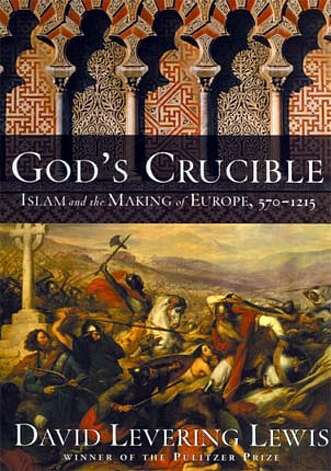
Lewis, God's Crucible

A book review of David Levering Lewis, God's Crucible: Islam and the Making of Europe, 570-1215 (New York: W. W. Norton, 2008).

In spite of the subtitle, Lewis' history of Muslim Spain (al Andalus) and Catholic Frankland (later Francia and still later France) is about an epic clash of civilizations—or, better, the clash of Islamic civilization with European barbarism.  It is an old-fahioned history that chronicles the rise and fall of dynasties and kingdoms and the many battles and wars that liter the history of both Islam and Europe.  Only in passing does Lewis point to the profound influence that Andalusian Islamic culture had on the development of Western Europe, and the reader who wants to discover what Europe learned from the Muslim East through Spain should look elsewhere.

In fact, God's Crucible is two histories, Islamic Spain and Christian Europe, that are united only by the immense episodic dislocations caused by their rubbing against each other like two gigantic, restless tectonic plates.  The Muslim East, including a variety of tribes from West Asia and North Africa, and Catholic Europe, also including a variety of peoples, pushed and shoved against each other from the invasion of Spain in 711 until the final eviction of Islam from the Iberian Peninsula in 1492.  Lewis concentrates on the first three centuries or so of the struggle, and makes a number of important observations in the midst of his chronicle.  He makes it clear, for example, that the Jews were a third presence in this history and, although much smaller in numbers, important actors in their own right.

God's Crucible is also an old-fashioned book in the attitudes it contains about Europe in the era after the fall of Rome.  While revisionist historians have discovered in early medieval Europe a dynamic world that made many advances in learning and technology, for Lewis post-Roman Europe was what previous generations of commentators believed it to be: a barbaric world trapped in the Dark Ages.  He emphasizes repeatedly that in comparison with Andalusian civilization with its great wealth and grand urban centers, Europe east of the Pyrenees was a cultural wasteland, ignorant and violent.  Almost never in this book do the Europeans come out looking good by comparison to the Arabs and other Islamic peoples on the western side of the mountains.  Most notable is the contrast between the way in which Andalusian Muslims and Catholic Europeans treated people of other faiths.  By-and-large, the Muslims were relatively tolerant of at least Judaism and Christianity and left Jews and Catholics to their faith so long as they paid their taxes and remained loyal to their rulers.  Euorpean Catholics behaved in the opposite manner with respect to Islam.  More largely, the Christians contributed little to Andalusia other than their skills at and penchant for war while Muslim Spain made important contributions to the development of Catholic Europe.  Whether or not one wants to go so far as to charge Lewis with harboring a bias that distorts the realities of the past, he certainly leans strongly in the direction of Islamic Spain and away from Catholic Frankland.

Given his pro-Andalusian perspective, Lewis argues that the Christian victory at the famous Battle of Poitiers (732), in fact, did not save Europe from Islam.  Rather it was developments in the Islamic world that conspired to halt the Arab advance into Europe.  He agrees, that is, with Muslim historians of the time who he says rightly blamed "their own internecine preoccupations as the real reason for Christian Europe's survival." (p. 178)  He also speculates that Europe was actually worse off for its victories over its Muslim invaders and their failure to conquer the continent.  Lewis writes, for example, "An ironic intelligence from another planet might have observed that if Carolingian Europeans believed that Charles the Hammer's victory at Poitiers made their world possible, then it was a fair question to ask whether or not defeat might have been preferable."  He continues, "The European shape of things to come was set for dismal centuries following one upon the other until the Commercial Revolution and the Enlightenment molded new contours." (p. 286)

That being said, for the general reader who exercises a healthy caution concerning Lewis' interpretation of past events, God's Crucible is still a helpful book—never mind all of the names, which can become a jumble at times.  He captures the complexity of the events he recounts and shows how various factions on both sides of the Pyrenees played off of each other.  The Muslim invaders of Spain, in particular, turned out to be a patchwork of ethnicities and social groups.  To a degree, he makes the case that Islamic rule of Spain was generally enlightened by the standards of the day, more humane than that later imposed on it after the reconquista by Christian forces.  Charlemagne also comes across well in Lewis' account of events.  But he seems to have been more of an anomaly than anything else, a brief interlude in the darkness as it were.

If not a great book, this is certainly not a "bad" book either.  There are a few nuggets scattered through it as well.  Lewis, for example, describes the work historians as that of being "prophets in reverse" (p. 314) by which he means that historians are able to see the budding of the future in events that the participants in those events simply did not see.  Thus, what was a period of prosperity still contained the seeds of future calamity, a fact clear only with the hindsight of a "reverse prophet."  The point here is that historians benefit from hindsight only to the extent that they carry out their research with due diligence and insightfully.  What they discover is often not obvious even to others in their own time, let alone to those in the era under study.  The true prophet is inspired to see what others do not see, which is not a bad description of the historian's craft at all.

As old-fashioned political and military chronicles of the past go, in sum, God's Crucible is a reasonably good read.  It contains some interesting insights.  It does the historian's task of revising previous accounts.  It exposes the main contours of the past.  And to the degree it is a one-sided account, its bias is reasonably clear and consistent.  It also contributes to an understanding of the history of European learning and science by placing post-Roman Empire cultural developments into their larger regional history.  In that context, the Byzantine Empire lurks on the fringes appearing from time to time as events unfold and trends develop.  This is not a great book, but it is also not a bad one.


Monday, March 4, 2013

Kugel's How to Read the Bible

A book review of James L.Kugel, How to Read the Bible: A Guide to Scripture, Then and Now (New York: Free Press, 2007).

Have you ever had the privilege of walking along a forest path with a naturalist?  As you walk, the naturalist will point out fascinating plants, evidence of animal life, and many small details that the uninitiated simply don't see.  More than that, the naturalist will see and describe the relationships between living things that make the forest a unique and amazing ecological system, a biosphere.  Kugel is that naturalist.  The Hebrew Bible is his forest, and How to Read the Bible is the path he takes the reader along through the forest.  It is a long path, amounting to 689 pages of text plus 82 pages of endnotes.  It is also a winding one that sometimes almost disappears into the  forest as Kugel regales the reader with interesting little tidbits that don't connect very readily to any larger thread (to mix metaphors).

There is, however, a larger thread, and Kugel takes us into the forest with a larger goal in mind, namely to ask fundamental questions about the meaning and purpose of the forest itself.  Modern biblical scholarship has radically transformed our understanding of the Hebrew Bible, which raises painfully complex questions for those who read it as people of faith.  To be sure, Kugel raises these questions only in fits and starts and often enough raises them and then blithely takes up again with  the tour of the forest only many chapters later to suddenly return to those questions.  But he does return to them.  The questions themselves are important ones for Kugel.  He asks them as a practicing Jew for whom the Bible has become problematic.  Where is God, most importantly, in the scriptures if they are "merely" the product of an elaborate, centuries-long, and very human process of editing?

Kugel begins with the observation that over the centuries there have been three layers of interpretation of the Bible (by "Bible," he always means the Hebrew Bible, the Old Testament).  They are: (1) the original intent of the stories and other contents of the Bible; (2) later centuries of interpretation that arose partly because original intent was eventually forgotten; and (3) modern scholarly reconstructions of original intent.  Well into his journey through the Bible, it turns out that level one is considerably more complex than we were led to believe at the beginning.  The Hebrew Bible is a patchwork of pieces of text assembled over many centuries by generations of editors who mixed, matched, added to, remixed, rematched, and added still more.  As we go through the book, moreover, we are aware of the fact that in ancient times there were variant readings, which also changed over time.  Kuegel places, for example, all Christian readings of the Old Testament into level two and, at times, shows how they were similar to and differed from Jewish readings.  In modern times, he points out we inherited level two readings as being the right way to read the Bible.

With this framework, Kugel walks us through the Hebrew Bible beginning at one end and going to the other.  Frequently, he introduces the reader to level two (traditional) readings of the text and then goes on to describe level three excavations (scholarly) of the same text.  Sometimes he doesn't.  The fact is that Kugel has assembled a book that displays some of the characteristics of the Bible itself.  He frequently introduces a portion of the Bible, talks about it a bit, and then blithely walks on without a conclusion or any clue as to the importance of that particular portion.  He simply sees a pretty little leaf, stops to admire it, and then off he goes again.  The book is also filled with lengthy quotations from the Bible put there evidently on the assumption that readers are too lazy to go and read the Bible for themselves (he is probably right).  These frequent and lengthy quotations only serve to add to the sense that the book is disjointed and itself "compiled" from many fragments.  Often enough, furthermore, Kugel ignores the title of the book and fails to tell us how to read the individual texts he is talking about.  At other points, however, he illuminates the Bible and provides helpful commentary on both the traditional and scholarly readings of key biblical texts.  He helps Christian readers to understand where their inherited interpretations of the Old Testament stand in relationship to the text and to later Jewish interpretations.

The central thesis of the book is that the traditional assumptions we have inherited concerning the meaning of the Hebrew Bible and the assumptions that scholars bring to that reading are in conflict.  He states, "These assumptions have essentially created two different Bibles, the ancients' and the moderns'." (p. 134)  The "central question of this book" is, "Which way of reading is the right one?" (p. 161)  Thus, the original "etiological narratives" of the Pentateuch, for example, were radically transformed by later generations of interpreters in ancient times.  Those narratives became "moral exampla" and "up-to-date guide[s] for daily life." (p. 362)  Kugel observes that, "the anonymous interpreters of the third and second and first centuries BCE changed utterly the whole character of the Pentateuch...No less formidable however, has been the activity of modern biblical scholars over the last two centuries." (p. 363) The scholars have undone the work of the ancient interpreters and once again made the Pentateuch into a collection of fragments.

In the course of his walk through the Hebrew Bible, Kugel pays particular attention to clues as to how the generations of editors assembled and reassembled the text until it reached its final form.  He also points to insights on various related matters, such as how the ancient Hebrews' understanding of God changed over time, the relationship of the Hebrew text to other ancient texts, the Christian understanding of the Old Testament, and even why Christians retained the Old Testament as a part of their scriptures.

Kugel, in a sense, saves the best to last.  His final chapter, "After Such Knowledge..." (pp. 662-689) brings together his questions and concerns about the impact of modern biblical scholarship on our understanding of the Bible—on his understanding of the Bible.  Modern scholarship has shown that the Bible is fragmented, self-contradictory, and a thoroughly human enterprise.  Modern scholars have "stripped the Bible of much of its special status." (p. 667)  He then comes to a crucial insight, namely that "what makes the Bible biblical is not inherent in its texts, but emerges only when one reads them in a certain way, a way that came into full flower in the closing centuries BCE." (p. 668, italics in the original)  At that time, the Bible began to be treated as wisdom literature, a compendium of divine truths, which in fact is the "real" Bible.  The real Bible, that is, is not found in the original fragments and snippets of which it has been woven.  The real Bible, the canon, is the body of interpretations with which it was read in ancient times long after it had been assembled.  The canon is text and interpretation, not just text.  Kugel closes with observations on what all of this means for Christian fundamentalists, Christian liberals, and Judaism, and at the very end of his reflections he concludes, apparently, that  in spite of the impact of modern scholarship on our understanding of the Bible, he must continue in faith to serve and have faith in the One served.  Those are my words, not his, but they capture I trust the sense he intended.  He admits that he brings us to the end of the tour with more of a whimper than a bang, but there it is, a Jewish biblical scholar's attempt to make the best of the realities of scripture as exposed by modern biblical scholarship.

For those who want to understand the Bible today and/or the challenges the world of science poses for people of faith, this is an excellent book.  Be patient with it.  Enjoy the way it wanders around.  Wait for the important insights.  Your time and patience will be rewarded.

Saturday, March 31, 2012

Tippett, Einstein's God

A book review of Krista Tippett, Einstein's God: Conversations About Science and the Human Spirit (New York: Penguin Books, 2010).

Einstein's God is an excellent introduction into a new place that people of science and people of faith are beginning to discover, a place that puts behind us the science and religion debate.  In this book, science and spirituality occupy the same space in a way that is both comfortable and not so comfortable.  Most of the inhabitants of this new space have stumbled into it unexpectedly and some of them are still not sure that they really belong in it.  it is a place for thinking new thoughts and making connections between things that seem unrelated.  Residents tend to ask unsettling questions.  They reject cliches, prejudices, and what seems only commonsense to the world at large, be it the religious or the scientific world.

In Einstein's God, author/editor Krista Tippett has pieced together segments of interviews with leading scientists, thinkers, theologians, and her own reflections.  The result is a beautiful exercise in dialogue, which is one of the key habits of mind in the new place of spirituality and science that we are discovering.  Tippett frequently asks good questions as she probes the thinking of those she interviews.  She is always their friend, but she is constantly seeking to dig deeper into their thinking.  In the book the interface between Tippett and her guests isn't always seamless, and a somewhat slipshod editing job resulted in repeating material in her introductions to each chapter verbatim in her commentary in the chapters.  It is a minor flaw.

The book opens with reflections on Albert Einstein's understanding of God, which has sparked a good deal of debate and controversy in some quarters.  Tippett relies on scientists Freeman Dyson and Paul Davies to discern Einstein's belief in Something larger that inspires a religious awe in those who study the mysteries of the universe.  She includes this quotation from Einstein himself: "My religiosity consists in a humble admiration of the infinitely superior spirit that reveals itself in the little that we, with our weak and transitory understanding, can comprehend of reality.  Morality is of the highest importance, but for us, not for God." (p. 40)  Einstein's unorthodox spirituality sets an important tone for the rest of the book.  It is a place for voicing unorthodox thoughts, as much scientifically unorthodox as theologically so.

A number of those Tippett includes in the book are medical scientists who are discovering that there is much more to us than our bodies.  They are finding that healing is as much about the human spirit as it is about muscles and tissue.  These scientists have come to realize that their medical and scientific training did not prepare them for the real realities of healing people.  Dr. Sherwin Nuland, for example, talks about the human spirit as being something greater than our consciousness that is a product of human evolution.  He speaks of the human spirit in almost religious terms and calls on religion and science to engage in conversations (a dialogue) for the sake of better understanding the human spirit (see p. 61).  Dr. Mehmet Oz, a surgeon, reflects on his experience of discovering the importance of faith and religion in healing.  He observes that as a physician, "I began to recognize that as dogmatic as I thought I could be with my knowledge base, there were certain elements of the healing process I could not capture.  And even if I was right in the science, I could be wrong in the spirit." (p. 74)

The book includes reflections on Darwin's views of religion and science, the contribution Hindu thought can make to understanding reality, and the implications of quantum physics for that understanding,  Janna Levin thus says that, "There are limits in quantum mechanics to how much we can ever really know.  There are fundamental limits to certainty." (p. 149)  Tippett's chapter on revenge and forgiveness, based on an interview with the psychologist Michael McCullough,  as much as any other points to the ways in which scientific and religious thinking intertwine in this new spiritual-scientific territory.  For McCullough, both revenge and forgiveness are important evolutionary strategies that are far more commonplace in our daily lives than we usually recognize.  He argues that we constantly exercise forgiveness as we "get along" with others, overlooking "occasional defects and mistakes." (p. 179)  McCullough is one of those who is convinced that we are slowly creating a better, more peaceful world.  The book also looks at the place of stress in our lives and the nature of depression.  All of this is timely, relevant to a better understanding of the world from a spiritual-scientific perspective.

Tippett concludes the book with a chapter "on the complementary nature of science and religion" with the short title, "Quarks and Creation," which features discussions with John Polkinghorne, physicist-theologian.  [See my review of Polkinghorne's Belief in God in an Age of Science (here).]  Covering a number of subjects including quantum physics as well as the possibility of life beyond death, Polkinghorne concludes that increasingly, "the science and theology conversation is getting more theological."  Theology is posing more of the important questions that both science and theology must grapple with including questions about the nature of humanity and about the possibility of "continuity between life in this world and the world to come."  He says, "And that's a healthy development.  You want the conversation to be very even-handed in that respect." (p. 279)  Polkinghorne's conclusion is evidently Tippett's as well, because she doesn't include a conclusion of her own.  Those are the last words in the text.  It is a hopeful, helpful conclusion: dialogue is taking place.  It is meaningful, honest, and respectful dialogue aimed at making sense of a mutual search for understanding and wisdom.

I highly recommend Tippett's Einstein's God to those who are concerned with the relationship of religious faith and science today.  It is one witness to the way in which religious values, attitudes, and perceptions are finding a new place in our scientific age.  It is also witness to a discovery more and more scientists are making at the boundaries of their fields of study, namely that there is Something beyond those boundaries that is as real as anything but not quite in ways that scientists have usually considered real.  Quantum physics, in particular, is having a truly humbling impact on the world of science.  Reality is so not like what scientists have thought it to be that more and more of them have had to acknowledge that science alone is incapable of comprehending What Is Becoming.  Einstein's God takes its readers to the place where humbled scientists and equally humble people of faith are seeking to better understand spirituality and that which lies Beyond and Within the human spirit.  This is a winner.


Saturday, February 25, 2012

Reflections on Rick Santorum"s View of Faith

Former Sen. Rick Santorum (R-PA)
Former Senator Rick Santorum (R-PA) has injected religious concerns and issues into presidential politics in a way that has delighted some, angered others, and raised again the thorny issue of the relationship of religious faith to politics.  Drawing on a speech that Mr. Santorum delivered at the Oxford Center for Religion & Public Life in August 2008 (here) and his Q& A responses (here), a speech he gave at Ave Maria University that same month (here), and a talk he gave recently at Grace Church, Eden Prairie, Minnesota  (here), I would like to  describe Rick Santorum's faith as best I can and then reflect critically on the potential impact of his faith on a Santorum presidency, as unlikely as it seems now that there might ever be one.

In his book, Dynamics of Faith (HarperOne, 2009 [1957]), Paul Tillich defines "faith" as "the state of being ultimately concerned" and writes that, "the dynamics of faith are the dynamics of man's ultimate concern."  When Santorum spoke to the Eden Prairie congregation, he affirmed that Jesus Christ is his saviour, God, role model, teacher, and the center of his life.  He spoke of Jesus as "my friend."  More generally, he often refers to the fact that he encountered God in a deeper way once he entered the United States Senate in 1995.  Thus, personally, Rick Santorum's faith is in Christ.  At Grace Church, he spoke of the importance of grace in his life and of embracing the Cross.  He spoke of the world as broken and fallen and drifting further and further away from Jesus.  In his whole life, Santorum wants to witness for Christ, be faithful to him, and not separate himself from him.

There is more to his faith than Christ, however, and it is here that the true nature of Santorum's ultimate concern becomes harder to track.  In his speech to the students at Ave Maria University, he said that in his upbringing in Western Pennsylvania there were two important influences.  First, he was raised in a "Catholic ghetto," and the Catholic faith stuck with him.  It was this faith that "took off" in the Senate.  At the same time, his parents taught him an inmmigrants' love for America.  He is not just a faithful Catholic Christian.  He is also a faithful son of America.  And this is where things become confusing, because in his public speeches it frequently seems that the boundaries between these two concerns are porous and ill-defined.  God and nation blend to such a degree that they can seem to be two facets of a single ultimate concern.

These two, God and nation, especially seem to coalesce into a unity in Santorum's concept of Christendom, which means apparently any society that gives faithful allegiance to Christ and lives by the "Judeo-Christian" code of morals and values.  Most generally, however, he defines it negatively.  He is painfully aware that Christendom is under attack in America, indeed seems to be all but lost.  The enemy is secularism, which is embodied in many dangerous forms including the mainstream media, academia, left-wing radicals, the ethos of the 1960s, Democrats, Hollywood, the NBA, liberal so-called Christians, evolutionary thinking, atheism, homosexuality, and supporters of abortion.  He believes that Western Europe has already fallen under the influences of secularism, and his is convinced that President Obama intends to take the United States down the same path to secularity.

In his Ave Maria speech, Santorum described the growth of secularism in America in an insidious process that is destroying the nation's traditional values and its connection to its Judeo-Christian heritage.  He states that prideful, vain academia fell first to secularism followed by mainline Protestantism, which he sees as no longer being Christian.  The next domino to fall was American culture, and while he didn't give a precise date to the secularization of culture comments in his Cambridge Center presentation suggest that it was the 1960s, which he equates especially with sexual immorality.  According to Santorum, American politics and governance resisted secularization until the last twenty years or so partly because ordinary Americans still elected their officials.  The nation, in other words, has remained more faithful than academics, some Protestant denominations, and many of the carriers of culture.  His feeling that he didn't really find God until he became a senator and his insistence that many people on Capitol Hill are faithful Christians reinforces his sense of the residual faithfulness of the nation.  Christendom, then, is an all-encompassing concept that covers culture, politics, ethics, and of course religion.  Church and state may not be one, but they should be congruent and share the same faith and moral code.

Rick Santorum speaking at Ave Maria University, 2008
Mr. Santorum believes that a spiritual conflict is taking place in America between Christendom and secularity and that he is a combatant, almost a gladiator in that war.  As he said at Ave Maria University, Satan is attacking America.  He told the students that God needs them to be soldiers of faith, and he assured them that victory was certain.  At the Cambridge Center, he stated in his opening remarks that he saw evidence of "a very great divide in American politics" in which the nation "is wrestling with its own Judeo-Christian identity."  He went on to brand the Democratic Party as a key agent of secularization, and he has a deep-seated mistrust of President Obama whose political agenda, he believes, is "a more secular, government-driven, top-down, elitist culture, which is more reflective of what we're seeing in Western Europe."  Mr. Santorum believes himself to be at war in what is a "life struggle here in America."

Santorum rejects the idea of multiculturalism, which he identifies with the values and attitudes of Western Europe.  Multi-culturalism teaches that Western culture is not superior to other cultures and may even be inferior to them.  In a recent article entitled, "Multiculturalism Threatens America," he recounts how his grandfather left fascist Italy and migrated to the coal mines of Pennsylvania in order to live in America, a land of equality.  But now, he writes, "As a result of multicultural relativism, however, we are seeing the American aspiration eroded, our common purpose lost, and a 're-appearing tyranny and oppression' that is not only poised against us abroad but is also pointing its dagger at us here at home."

The struggle is not, moreover, just in America.  If the agents of secularity are the domestic enemies of American faithfulness, Islam is its external enemy.  At the end of the Q&A session at the Cambridge Center, Santorum  criticized President George W. Bush for failing to identify Islam as America's enemy.  President Bush and his State Department refused to acknowledge that Muslims are a people motivated by faith, and they are in a religiously-motivated holy war directed against America.  Santorum specifically identifies, in the article on multiculturalism cited above, Muslim communities in America as being a danger because they resist assimilation into the nation.  He stated at the Cambridge Center that it was part of his task to warn the American public of the dangers of Islam.  It was not a politically popular thing to do, "but I'll continue to talk about it."  It was on this note that he ended that presentation.

At the end of the day, Rick Santorum places his faith in Christ, which drives him to seek and to fight for God's will.  As he understands it, God wills that America be restored to its place in Christendom and that it reclaims its Judeo-Christian heritage.  He feels that in this struggle he must be a spiritual person who is honest, stands on his principles, speaks forthrightly for what he believes, and takes public policy positions consistent with his faith. This is what motivates him to run for the presidency. He wrote in the article on multiculturalism, "Because we are an optimistic people, Americans generally do not face up to challenges until we absolutely must. In a brewing crisis, we need a leader who has the political courage to speak the truth not only about our enemy but also about ourselves; a leader who has faith in all we are as a people, to inspire America and keep her free, safe and good."  Santorum's faith is intense and driven.  In his chat with the Grace Church congregation, he said that his personal faith journey "has been through fire."  He has had to stand up and fight for what he believes is right at some sacrifice to himself and his family.  He feels himself frequently attacked and deliberately misunderstood especially by the mainstream media.

ab

Rick Santorum wears his faith on his sleeve.  It matters deeply to him.  It also matters to the rest of us because he has become an increasingly significant political voice over the last few months. The most recent set of national polls (here) show Santorum leading the Republican field by an average of 5.2%.  If he does become president, furthermore, his profound reliance on his faith, which is what motivates him to seek office, will be an important factor in how he governs.  It will inform the policies he pursues, his style, and his attitudes—things that matter to the rest of us.

Viewed theologically, Santorum's faith displays certain potentially troubling characteristics.  To begin with, it is intensely dualistic.  There are various kinds of dualism, and the type that Santorum articulates is often called "moral" dualism, which traces its roots to ancient Persia's belief the god of good and the god of evil are engaged in a cosmic battle.  A dualistic worldview of this type thus divides reality into two distinct camps, one good and the other evil.  There is no overlap.  Humans have to choose sides, and they can't be allied with both.  Indeed, all of reality is divided into categories of good and evil.

Moral dualism normally comes with other concepts, most notably exclusivism, a battlefield mentality, and a rejection of compromise.  If the universe is sharply divided into spheres of good and evil, then there is only one or the other.  It follows that if Christianity is good all other forms of belief that do not conform to Christianity are evil.  Mr. Santorum thus considers mainline churches to no longer be Christian because they do not conform to his understanding of the Christian faith.  By the same token, there can be no such thing as a "liberal Christian," because liberals believe things antithetical to the Christian faith as he understands it.  In his speeches, he habitually divides people, policies, ideas, and political parties into the categories of Christendom (good) and secularism (evil).  And it follows from his exclusivism that Santorum considers himself to be involved in a great battle between good, embodied in his Judeo-Christian heritage, and evil, embodied in secularism in all of its manifestations.  Santorum has used the metaphor of fighting in the arena to describe his political style.  And from all of this it follows that when it comes to the fundamentals of his faith he cannot compromise.  He must stand up for what he believes.

That is to say, Mr. Santorum shares the marks of the tea party adherents whose unwillingness to compromise has brought Congress to a standstill and seriously weakened the federal government's ability to govern.  If he remains true to his principles, a Santorum presidency is likely to be short on compromise and long on seeking to impose his theocratic agenda on the nation as best he can.  Now, with his pre-tea party experience in Washington, he may be better able to govern than the tea party faction has thus far, but the rhetoric we have heard during the Republican primaries suggests otherwise.

But, let's back up to the word, "theocratic."  It sounds incendiary, but in fact it is a good name for Santorum's stated philosophy of government, which is to restore America's Judeo-Christian heritage and return the nation safely to the fold of Christendom.  According to Wiktionary, the word "theocracy" means either rule by God or by government under the control of a church or state-sponsored religion.  Santorum wants to restore the rule of God over America, and in doing so he would certainly sponsor his understanding of faith as much as possible as president.  "Christendom" is a political term.  It means the place or area in which Christianity rules.  Christian prayer would return to the schools.  Christian religious displays would be permitted on public property.  As president, Santorum would pursue a pro-life agenda and, apparently, work to end the use of contraceptives.  These are theocratic measures, and he would govern as theocratically as the realities of American politics will allow.  He says so repeatedly, and we should believe him.  The ideas of the Judeo-Christian tradition and Christendom as Santorum uses them, furthermore, encompass all that is good.  They are, strictly speaking, imperial categories.  There is nothing good outside of them, and they do not recognize the validity or value of any beliefs, values, attitudes, or behaviors they do not encompass.

It is important to understand, moreover, that Santorum identifies the larger set of Republican policies with God and faith as well.  He says that the Republican Part is the party of faith, thus his whole conservative agenda is equally a part of his theocratic agenda.  We are already seeing what this means in Wisconsin, Virginia, and other states where the tea party Right won control of state government.  It means little short of a crusade to repeal the social, economic, and political program of the Democratic Party and, in a sense, to return America to 1928.  Again, the word "crusade" is the correct label for the political agenda that tea party governance pursues, the kind of governance Mr. Santorum advocates.  A crusade is a war on evil—in this case, the evil of secularism.  It is a war on the agents of evil, that is the long list of "secularists" given above.

Thus, another key characteristic of moral dualism is the tendency of moral dualists to demonize their opponents, considering them as enemies rather than merely as opponents.  Mr. Santorum cannot believe that President Obama is also a man of faith because his belief system is liberal.  Instead of accepting the president's description of his own personal conversion to Christianity, Santorum states that the president joined an influential church on Chicago's south side in order to further his political agenda.  More largely, he believes that Democrats plan to turn America into a secularized state after the model of Western Europe.  Liberal churches are no longer churches at all.  While it is his right to believe all of these things personally, it will make it much more difficult for him to govern all the people when he believes that so many Americans are carriers of the evils of secularism.  How will he find sufficient common ground with Democrats to govern given his demonic view of them?  How will he compromise when compromise is necessary to get things done?  How can he find common ground with enemies with whom he has nothing in common so that there is no place that can be called "common ground"?  These are important questions.

Viewed theologically, Rick Santorum has fallen into the trap of placing his ultimate concern in things that are not ultimate.  In Dynamics of Faith, Tillich describes this danger of faith.  It begins with the failure to recognize the fact that there is something about every truly ultimate concern that cannot be grasped and that is profoundly beyond the understanding of the faithful.  Tillich says that faith entails risk and courage—risk because we can never be entirely sure that our ultimate concern is truly ultimate and courage because by our very nature we must take the risk of having faith.  If we are absolutely sure that our ultimate concern is ultimate, we can be sure it is not.  By its very nature, an ultimate cannot be grasped in that way.  Tillich argues that doubt is an important element of faith because we can't be absolutely sure of our ultimate concern.  The presence of at least some residual doubt is an indication that our ultimate concern may indeed be ultimate.  Tillich observes that we must therefore be self-critical of our sense of ultimate concern.  Speaking as a Christian theologian, he says that people of faith must always stand "under the Cross" by hearing criticism and subjecting ourselves to prophetic judgment and doubt (p. 33).

Mr. Santorum, so far as his public pronouncements are concerned, displays all of the traits of a "true believer" who does not doubt the ultimacy of his ultimate concern.  Furthermore, he generally treats a preliminary, finite reality—the United States of America—as an ultimate concern.  He identifies God with nation to the extent of giving his ideal America the name of Christ, Christendom.  Throughout Dynamics of Faith, Tillich repeatedly uses nationalism as a prime example of a finite reality that is frequently treated as an ultimate concern.  He insists that finite realities cannot bear such weight and necessarily collapse, betraying the faithful with their failure.  Tillich calls the act of putting one's faith in a finite reality "idolatry."  He warns of the grave danger especially of turning faith symbols and stories into idols, the Bible itself being a prime example of a finite reality that millions of faithful people treat as if it is God.  Tillich calls this form of idolatry literalism and writes, "Literalism deprives God of his ultimacy and, religiously speaking, of his majesty.  It draws him down to the level of that which is not ultimate, the finite and conditional." (p. 60)

This is what Mr. Santorum has done.  In his failure to be doubtful and critical of his faith and in associating a finite reality with God to the extent that God and nation become an ideological unity, he has turned "God" and "nation" into idols.

He, of course, would disagree, which his right.  The thing is he wants to be president, and his form of idolatry demonizes all who disagree with his theology and his politics, which he sees as one.  These demons, who are not just his enemies but also God's enemies, include liberals, Democrats, mainline Protestants, union members, homosexuals, people who advocate pro-choice positions, Muslims, Western Europeans, academics, members of the mainstream media, and in fact moderate and "establishment" Republicans (RINOs) as well.  And that is a problem because these groups include a lot of good Americans and good people of faith who love their country just as much as Mr. Santorum does.  He cannot accept that fact any more than he can accept the idea that Barack Obama is a born-again Christian.  And that is a problem.

It is also a problem that Mr. Santorum, with his dualistic crusader mentality, does not accept fundamental realities of American life.  First, we are a multicultural nation and draw great strength from that fact.  Second, according to the highest law in the land, the Constitution, the United States is a secular state.  We do not have a state religion or church.  There are no religious tests for holding public office.  The state does not regulate the practice of religion so long as that practice does not violate the civil laws of the land.  Third, tens of millions of Americans are liberals and have a rightful place in deciding what kind of a nation we live in.  They are not enemies of their nation, and they are Mr. Santorum's enemies only because he chooses to make them such.

In sum, a Santorum presidency, would be reactionary, divisive, and manipulative.  The goal of his administration would be to gain theocratic control of the nation and limit to the largest extent possible the power and the voice of his enemies.  The policies and governance of the tea party state governments foreshadow those of a Santorum presidency.